What are Alternative Digital Credentials (ADCs)?
Alternative Digital Credentials (ADC) are non-traditional (non-degree) online credentials offered by institutions of higher education. ADCs provide agile, flexible, economical, secure, electronically sharable records in a format that can be used by learners to demonstrate certain learned achievements, skills, and competencies. These are often earned as complements to traditional academic degrees, minors, and certificates as well as in co-curricular settings. ADCs provide a legitimate, verifiable documentation of learning not captured by traditional credit-hour transcripts. Examples of ADCs might include co-curricular experiences like peer-education, leadership experiences, training experiences, etc.
At Mizzou, alternative digital credentials are supported through a collaborative partnership between the Office of the Provost and Student Affairs.
Terms to Know
- Digital badge: the visual representation of having earned a micro-credential. Digital badges can be shared on various online platforms to showcase the earner’s achievement.
- Micro-credential: represents the acquisition of knowledge and mastery of specific skills or competencies.
- Digital badging systems: refers to the technology used to display the badges.
- Student learning outcome: clear, measurable statements describing the knowledge, skills, and abilities learners can demonstrate upon completion of a learning experience.
- Stackable ADC: micro-credentials that may be combined or sequenced to form a larger credential.
Benefits of ADCs
- Provides ways to recognize and document learning, skills and competencies not captured by our current policies, including but not limited to:
- those earned outside of the traditional classroom setting.
- those not recorded with a traditional transcription of credit hour.
- Helps learners clearly communicate their skills and experiences, supporting career readiness and outcomes.
- Enables students to curate learning pathways and integrate learning experiences across experiences.
- Offers the university meaningful insights into student learning and skill development across a wide range of experiences.
In August of 2022, the Alternative Digital Credential Policy (Section I) was approved by Faculty Council. ADCs are intended for Mizzou students, including non-degree seeking students. University of Missouri micro-credentials that are non-credit bearing and free-standing will be free to all participants.
What to Know About ADC Requirements:
- All ADCs must match the mission and culture of the University of Missouri.
- ADCs must meet University standards for issuance.
- ADCS may be offered by academic or non-academic units
- ADC proposals must originate from the sponsoring unit and may be offered by any MU division or department provided the unit complete the appropriate proposal process for approval.
- ADCs are issued by the Provost Office or the Division of Student Affairs using University approved software platform, technical and design standards.
Three Types of ADCs
- Credit-bearing ADCs: Receive academic credit which is reflected on the MU academic transcript and must be assessed.
- Non-credit bearing & Assessed ADCs: Do not receive academic credit and will not be reflected on the academic transcript but must have clear learning outcomes for skills and competencies that are assessed.
- Non-credit bearing and unassessed: Issued for unevaluated learning accomplishments, such as the completion of a series of tasks, attendance at events, or for learning that has not been assessed.
At this time, Mizzou is only issuing ADCs that are non-credit bearing and assessed.
All of Mizzou’s ADC badges conform to the Open Badges standard from the IMS Global Learning Consortium – 1EdTech. Open Badges provide a format for digital badges and include meta-data about the underlying requirements and learning objectives, academic work, and how it was assessed.
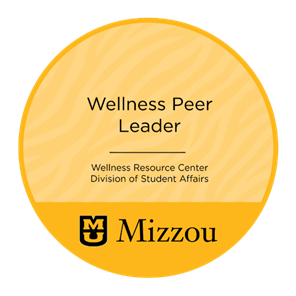
Each type of ADC has a Mizzou official, branded design, customized with each micro-credential name. Student Affairs, Wellness Peer Leader is used to illustrate an assessed, non-credit bearing ADC:
- Every proposal needs to meet the standards for assessed/unassessed, credit/non-credit according to Alternative Digital Credential Policy (Section I).
- Levels and type distinctions. All ADCs must meet University standards and clearly communicate the type of credential they represent. When ADCs are issued in the same subject area at two or more levels or types (assessed/unassessed, credit/non-credit) of competency, the levels must be clearly defined and obvious to the public.
- Issuance. ADC completion will be recorded and issued using the current approved campus badging or other ADC system.
- Records of ADCs will be maintained in the data warehouse, or other university identified storage in accordance with the Records Retention Policy.
- ADCs may fulfill the requirements of a non-credit, credit program (a combination of credit and non-credit), or contribute to requirements that meet workforce demands, but they need to match the mission and culture of the University of Missouri.
Learning Outcomes
Each ADC will be required to have learning outcomes(s) indicating what students will know or do when they complete the micro-credential (skills achieved). These should be specific enough, using active verbs, to communicate clearly to students, parents, and other stakeholders what was learned. Refer to Using a Learning Taxonomy for examples or additional assistance.
Stackable Credentials
Credentials may be combined or sequenced like building blocks where each short-term credential that a person earns builds into a higher-level credential. ADCs can be stacked vertically, horizontally, or both. Vertical stacking is the most common in which a single topic is explored in advancing detail. Horizontal stacking is the acquirement of knowledge across several topics. Hybrid stacking is a combination of both vertical and horizontal stacking, where learners explore multiple topics in increasing levels of difficulty.
Approval is required for each ADC that will be part of a stackable credential as well as the stacked credential. For example, if you have three ADCs that will stack to create a fourth comprehensive ADC, all four will need individual approval.
Skill Tags
Skill tags are one-to-three-word descriptions of the skills that are acquired or demonstrated by participating in an ADC. Skills tags make up a part of the contextual information provided for digital badges alongside the title of the micro-credential, description, and date received. Canvas Credentials partnered with Lightcast to display skills directly from your learner’s badge award. The Lightcast skills library describes skills (such as “Analysis”), highlights related skills, and lists the top companies that include the skill in their job postings. The ADC application provides instructions for identifying skill tags that align with an ADC.
Interested in Creating an ADC?
The following are national recommended best practices and should be considered when you are creating your ADC:
- Given that ADCs should be designed to offer learners specific skills, abilities and/or knowledge, it is important during the planning of the ADC to identify who those potential learners will be, what specifically they are going to learn or learn to do, how that learning will be assessed, etc.
- Think smaller and very focused on identifiable skills and specific learning outcomes. Take larger and/or broader learning experiences and break those into chunks.
- Conceptualize the ADC in hours, not years.
- Practice creativity, innovation, and consider more flexible delivery options.
- Assessments should be straight forward and directly aligned with learning outcomes.
- Create stackable ADCs when possible. Each ADC should have value on its own by delivering specific skills, knowledge, and experiences, but each ADC can also put students on their way to earning the next credential. Consider making a series of ADCs with beginner, intermediate and advanced micro-credentials.
- The ADC must have a job market focus, keeping in mind local, state, national, or international markets. This helps to provide opportunity for industry connections and partnerships. The proposal needs to be informed by current market data and align with relevant industry standards. When possible, consider current market demand and future needs.
- ADCs should provide workforce ready skills, knowledge, and experiences that will not be outdated in a short period of time. This helps to make the student learning visible to employers and other stakeholders.
- These should be kept consistent with Mizzou’s mission and strategic goals, academic quality, and rigorous standards.
ADC Proposal & Approval Process
To propose a new ADC at Mizzou, the ADC lead must complete the application via MU Engage. The ADC lead is MU faculty or staff who are coordinating the ADC, or a designee.
After Applying
Once the proposal is submitted, it will be reviewed by the identified supervisor in the application process. Following this, the ADC will be reviewed and approved by the Provost Office. If the sponsoring unit is in the Division of Student Affairs, it will be reviewed and approved by the Vice Chancellor for Student Affairs. Considerations for granting approval should evaluate the quality, market need, and financial sustainability of the learning experience.
Once approved, the ADC administrator in the Provost Office or Division of Student Affairs will build the ADC in Canvas Credentials badging platform. Once the ADC is set up and ready to be offered to students, all parties involved will be notified. When the ADC is ready to be awarded to the students, the ADC lead will notify the Provost Office or Division of Student Affairs and provide the list of students and their @umsystem.edu email addresses.
Requirements should be tracked in Canvas (if the ADC is for credit) or MU Engage (if the ADC is non-credit). Students will have a ADC conferred in Canvas Credentials once the student has completed all requirements. Students can upload other badges and will retain access to their canvas credentials account post-graduation.
For questions regarding ADCs or the application process, please contact umadc@missouri.edu
For questions regarding MU Engage, please contact engage@missouri.edu.