Published on
Updated on
Reginald Rogers, Jr., PhD, director of graduate studies and associate professor within the University of Missouri College of Engineering, led the spring research module for the Discover and Discover STEM programs within the Office of Academic Access and Leadership Development (AALD).
Geared toward an exploration of nanomaterials, and their broader implications for clean water access, this module directly paired scholarship with societal impact. For Rogers, this type of exploration is critical for undergraduate students.
“This research module provides a vehicle for students to open their imagination and come up with innovative solutions that will inspire them to explore further. Creativity-based training also enhances sense of belonging and increases the desire of early-stage undergraduate students to remain in STEM fields.”
Thirty-nine undergraduate students delved into the microscopic world of nanomaterials and their relation to one of the world’s most important resources: water. Rogers, an associate professor of chemical and biomedical engineering, focuses on the necessity of adequate access to clean water for the longevity of humans and animals. This project utilizes nanomaterials to respond to the challenges of daily living without proper water treatment.
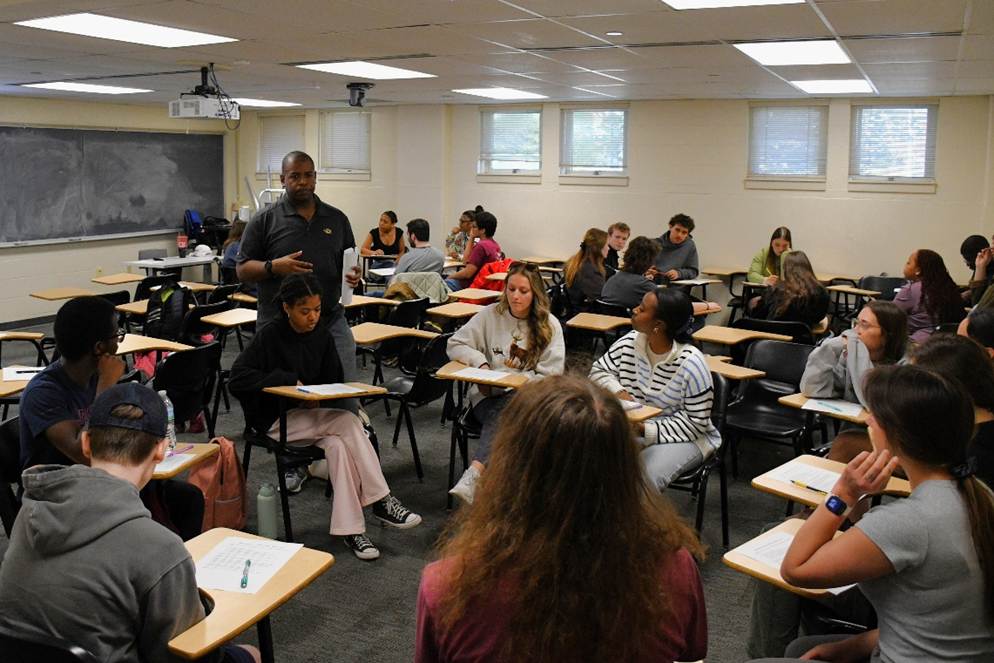
Designed for exposure and exploration, this module relied heavily on research literacy and collaborative problem solving through think-tank style discussions. Participants began at the fundamentals — physical properties of nanomaterials — and then continued through an exploration of their advantages over state-of-the-art materials and the process of making nanomaterials to remove contaminants from a water resource.
Every element of the module reflected the interaction and inquiry essential to a develop a research process over time. For Rogers, collaborative interaction within the research environment is intentional.
“Research feeds off curiosity. Curiosity enhances the learning environment because everyone gets to play without fear of failure. That’s because most research fails before one discovers what works.”
Through the spring research module, as a small part of AALD Discover and Discover STEM program support, Rogers exemplifies what works. He encourages students to ask big questions and seek solutions with great impact.